" height="15.65460401053985px" id="E2hITFMIY" width="89px"/><path d="M 15.154 0 L 6.296 0 C 5.965 0 5.657 0.167 5.473 0.446 C 5.289 0.725 5.255 1.078 5.38 1.389 C 5.43 1.511 5.504 1.621 5.598 1.714 C 5.783 1.903 6.034 2.01 6.296 2.01 L 13.158 2.01 C 12.949 3.493 12.28 4.868 11.247 5.936 L 11.198 5.987 L 11.149 6.037 C 10.099 7.086 8.747 7.765 7.29 7.977 C 5.94 8.177 4.562 7.968 3.329 7.374 C 2.634 7.038 1.998 6.588 1.447 6.041 L 1.398 5.99 L 0 7.414 C 0.221 7.641 0.455 7.854 0.699 8.054 C 0.908 8.224 1.126 8.39 1.351 8.542 C 1.967 8.962 2.632 9.301 3.332 9.552 C 3.972 9.784 4.637 9.938 5.312 10.013 C 5.971 10.089 6.635 10.089 7.293 10.013 C 8.711 9.856 10.07 9.353 11.254 8.545 C 11.739 8.214 12.192 7.837 12.605 7.417 C 12.829 7.192 13.039 6.954 13.235 6.703 C 13.405 6.492 13.563 6.272 13.711 6.044 C 14.506 4.84 15.001 3.458 15.155 2.016 C 15.192 1.682 15.21 1.346 15.21 1.01 C 15.209 0.673 15.19 0.335 15.155 0 Z" fill="rgb(8, 46, 57)" height="10.070297475553705px" id="SUqhhb7Az" transform="translate(2.507 7.93)" width="15.210335938094289px"/></g></g></svg>)
Pharmaceutical Manufacturing
How Romynox resolves cleanroom issues in one single place
79 issues
Logged over 14 months
62 issues
Closed

About
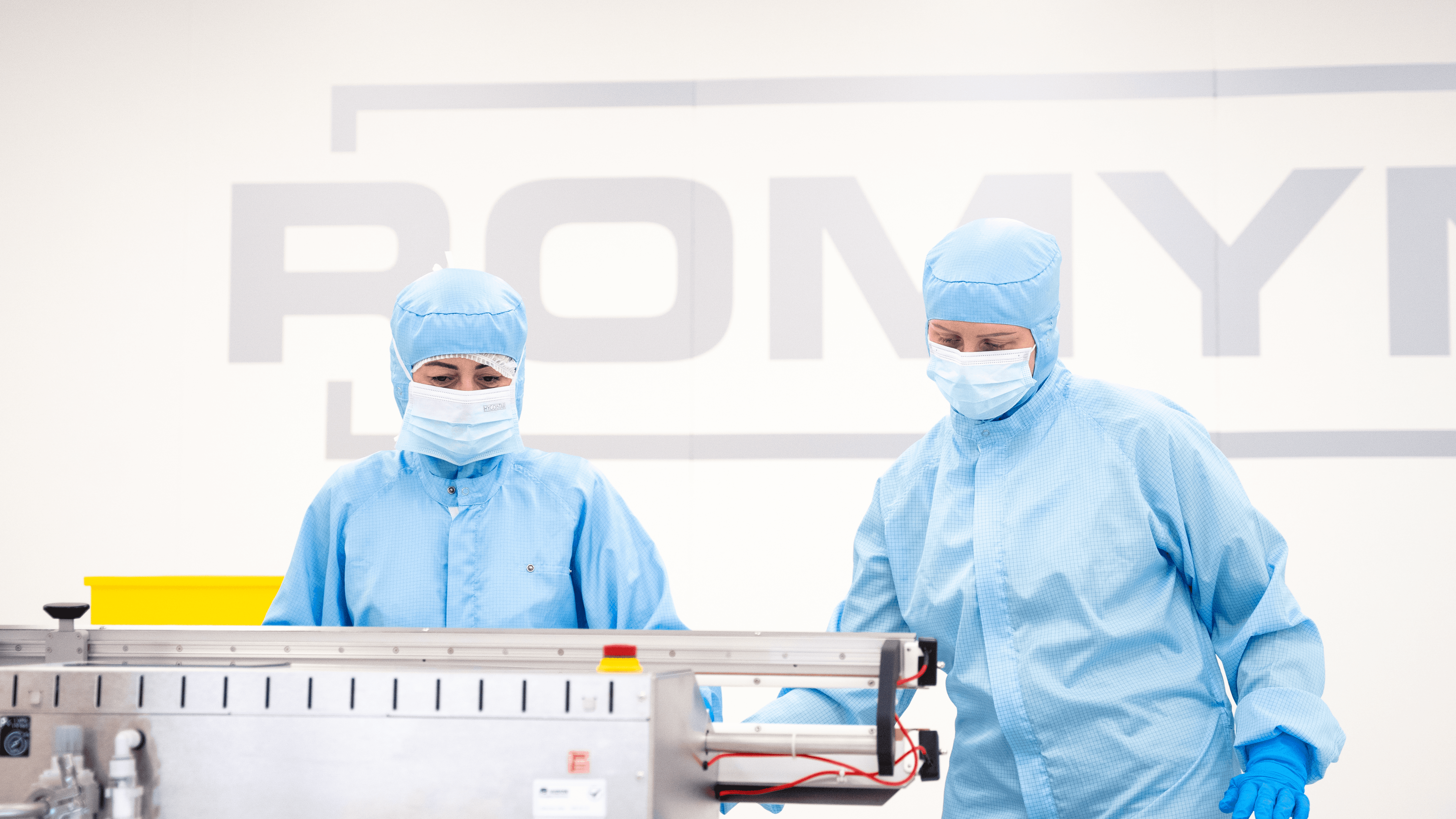
Romynox is a Netherlands-based manufacturer of custom single-use sets for the biopharma industry, supplying components for pharmaceutical production big conglomerates. Their cleanroom operations are in line with strict GMP regulation, with full traceability required at every production step.
Industry
Pharmaceutical Manufacturing
Company size
11-50 employees
Founded
2006
Share

"The biggest frustration with issues was miscommunication through email. Issues weren't being tracked in one place."
Romynox Team
The challenge
No central place where issues live
In pharmaceutical manufacturing, a mislabeled product isn't just an operational problem. It's a quality failure that can halt production, trigger a regulatory review, and in the worst case, reach a patient.
Romynox knows this. As a manufacturer of custom single-use sets for biopharma companies, their cleanroom operations are in line with strict GMP (Good Manufacturing Practice) regulations. Every component, every label, every production step must be traceable. Nothing can slip through unnoticed.
Until recently, when something went wrong, it got flagged by email.
Romynox's cleanroom team produces custom assemblies for international pharmaceutical clients. The process is meticulous: components are picked, labeled, inspected, assembled, re-inspected, packaged, and released across nine structured workflow steps that span from incoming goods to final dispatch.
With five people working in the cleanroom and production running five times the volume it did two years ago, the margin for error is narrow. A label printed without a customer name. A certificate number that doesn't match. A colleague who missed a step because she was new and still learning.
Small errors. High stakes.
Before Cargosnap's Issues feature, these problems were caught and communicated by email. The system worked. But emails got buried. Context got lost. And the quality manager had no single place to track whether an issue had been resolved or was still sitting open somewhere.
The other problem: the cleanroom itself. Operators working in gowning and gloves can't leave mid-production to sit at a computer. When an issue was spotted inside the cleanroom, reporting it meant finishing the step, leaving the environment, removing gloves, finding a workstation, and logging the problem, by which point the detail was already fading.
The solution
Issues linked directly to files, tracked from open to closed
Romynox already used Cargosnap extensively for their production workflows: nine structured workflows covering everything from incoming goods receipt to pre-assembly checks, cleanroom line clearance, assembly verification, and outgoing dispatch. The Issues feature gave them a way to connect quality exceptions directly to those workflows and the files they generate.
Their process is straightforward:
An issue is detected by an operator in the cleanroom, a quality check by the quality manager, or during the outbound release inspection.
The issue is logged in Cargosnap, linked to the relevant file and assembly number.
Three to four colleagues are assigned.
The issue stays open and visible until it is resolved and explicitly closed with a description of what was done.
The quality manager monitors all open issues and confirms closure.
The link to the file is essential. When an issue is opened, it sits directly under the assembly order it relates to. When the full production record is exported as a PDF — as clients sometimes request — the documentation is complete: every workflow step, every photo, every issue raised and resolved.
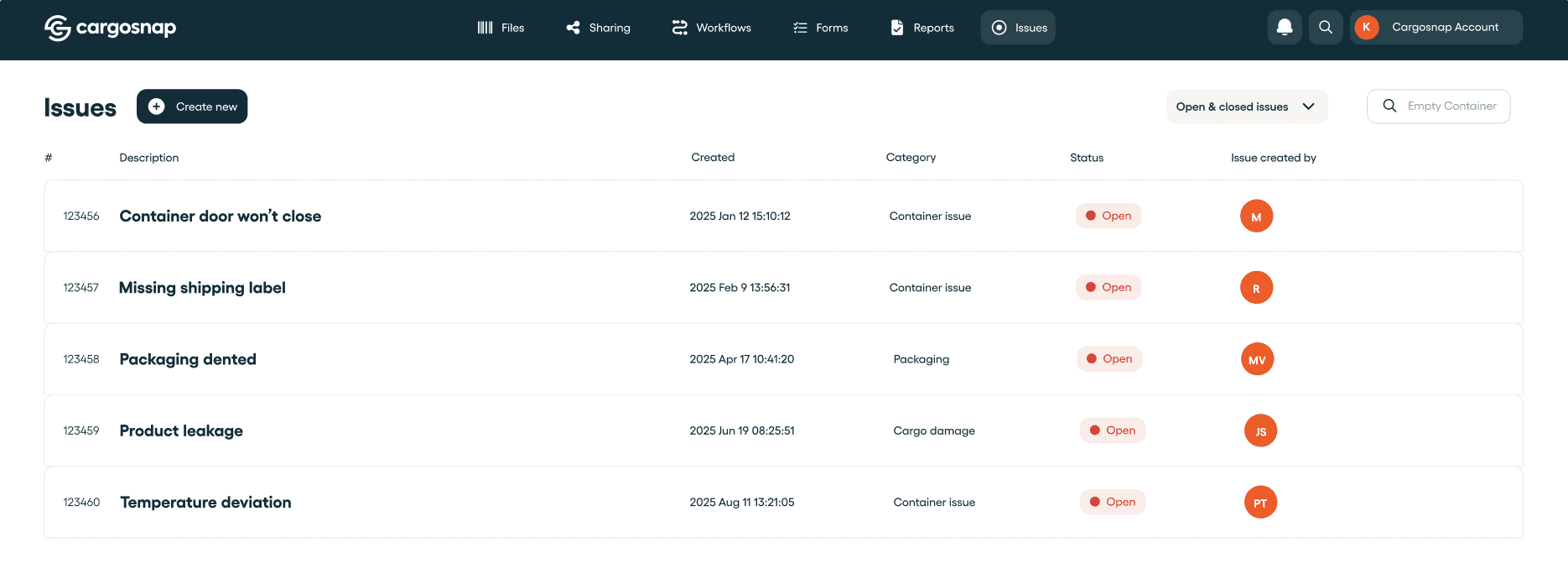
Platform example – Issue Management

"We need to trace every single step — from picking up the raw materials until we release the product. With date, number, who, where, when, why. If something goes wrong, you can do your root cause analysis. Cargosnap helps us do that."
Ali Zamani
Clean Room Manager, Romynox
The results
79 issues logged over 14 months. Of those, 62 are closed. The 10 currently open issues are all from 2026, actively in progress. Not forgotten.
2–5 issues per month on average, trending downward. In March the team logged five; by May it was two. "It's getting better," Ali noted. "That means we are improving."
The cleanroom team (four people) now handles all issue management together. Every issue has three to four assignees as standard, up from one or two when they first started using the feature. No issue is one person's problem.
Emails about quality exceptions have stopped. The team's answer to what they'd stop doing if structured issue tracking worked well: "Sending emails." That shift has already happened.
Issues are resolved in minutes or days, depending on complexity. A mislabelled sticker is fixed in ten minutes. A component that arrived from a supplier in poor condition may require a week of back-and-forth. Both types are tracked the same way: opened, assigned, resolved, closed.
What the team values most
When asked what the main benefits were, the Romynox team didn't pick one or two from the list. They picked all of them:
Saving time — no more chasing email threads
Fewer things fall through the cracks — every issue has an owner and a status
Better insight into recurring problems — patterns are visible across the issue log
Easier to prove resolution to clients — the full file, including issues, can be exported and shared
The connection to existing Cargosnap photos was rated essential. In a GMP-regulated environment where photographic evidence is part of compliance, issues that are linked to the same photos used in production records carry real weight.
Before, communication and resolution was mostly by email. Now everything is in one place. It's straightforward.
Evelien Weerdenburg
Quality Manager, Romynox